
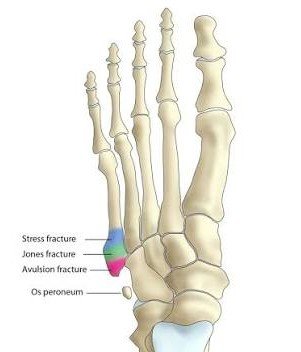
Fractures of the base of the fifth metatarsal are a frequent reason for consultation in the emergency room. Different areas at the base of this bone can be affected by a traumatic injury, and therefore, the clinical and therapeutic implications of the injury vary depending on which region of the fifth metatarsal is involved.
To classify these injuries, there are different variants or classification systems called:
- Dameron-Lawrence-Botte
- Stewart
- Torg
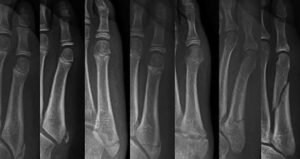
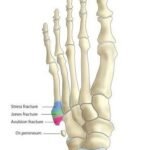
This is the Dameron-Lawrence-Botte classification , described in 1993 and widely used to describe these injuries:
- Zone 1 : Avulsion fracture of the tuberosity (styloid process) involving the proximal tuberosity, starting from the lateral cortex. With or without articular involvement of the metatarsocuboid joint. Can be treated without surgery.
- Zone 2: Jones fracture. Involving the distal tuberosity and the metaphyseal-diaphyseal junction, extending to the 4th-5th intermetatarsal joint. The tarsometatarsal joint is not affected. It can initially be treated non-surgically in the non-athletic population and surgically in the athletic population.
- Zone 3: Diaphyseal stress fracture. 1.5 cm proximal to the diaphysis, distal to the 4th-5th intermetatarsal joint. It can initially be treated non-surgically in the non-athletic population and surgically in the athletic population.
This article provides an overview of the topic:
Fractures of the base of the fifth metatarsal
This material was automatically translated from medicosradiologos.com.ar
For any comments or suggestions: radiologyzones@gmail.com