
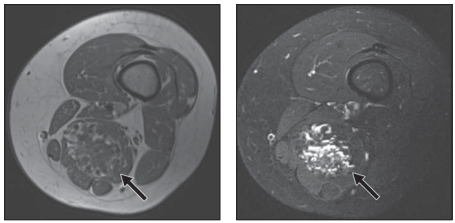
Tumors and soft tissue lesions present a diagnostic challenge, primarily due to the reporting physician’s anxiety about committing to a precise diagnosis or identifying the lesion; and secondly, because many such lesions are discovered incidentally during imaging studies performed for other reasons and, therefore, do not present associated clinical symptoms. Consequently, radiologists often encounter lesions of all types, which are incidental findings and whose evaluation they are unsure of.
Soft tissue tumors presented for imaging studies will be, or have already been, evaluated histopathologically. The imaging study generally aims to determine certain characteristics of the lesion, such as its extent, size, involvement of adjacent structures, and relationship to neurovascular bundles.
This work from the American Journal of Roentgenology presents a list of 8 steps to consider when describing a soft tissue tumor lesion, with the main purpose of excluding a malignant or sarcomatous lesion.
Soft-Tissue Lesions: When Can We Exclude Sarcoma?
Steps:
- Could it be a normal structure? (an anatomical variant?)
- Does it contain predominantly liquid?
- Does it contain fat?
- Does it have prominent areas of low signal on T2?
- Is it inside or near a joint?
- Is it related to a tendon or ligament?
- Is it predominantly vascular?
- Is it related to a normal structure?
In this way, by answering the aforementioned questions about each lesion, it will be possible to approximate its origin, rule out certain abnormalities, and propose some differential diagnoses. Since most lesions will be studied histopathologically, the radiologist can indicate the most appropriate site of the lesion to obtain a diagnostic benefit.
The American College of Radiology is currently developing the Soft Tissue -RADS.
Soft Tissue-RADS™ is a risk assessment tool designed to standardize the approach to the reporting of soft tissue tumor and tumor like lesions. Soft tissue tumors represent a diagnostic challenge, with many being benign and some exhibiting aggressive or malignant characteristics. Accurate differentiation relies on clinical and imaging assessments with limitations in MRI-based accurate histopathologic diagnosis of sarcoma.
The American College of Radiology Committee on Soft Tissue-RADS aims to improve consistency and confidence in soft tissue tumor and tumor-like assessments by integrating a multidisciplinary approach, illustrating a structured reporting framework using standardized lexicon, and proposing a work-in-progress scoring system that outlines management recommendations.
This material was automatically translated from medicosradiologos.com.ar
For any comments or suggestions: radiologyzones@gmail.com